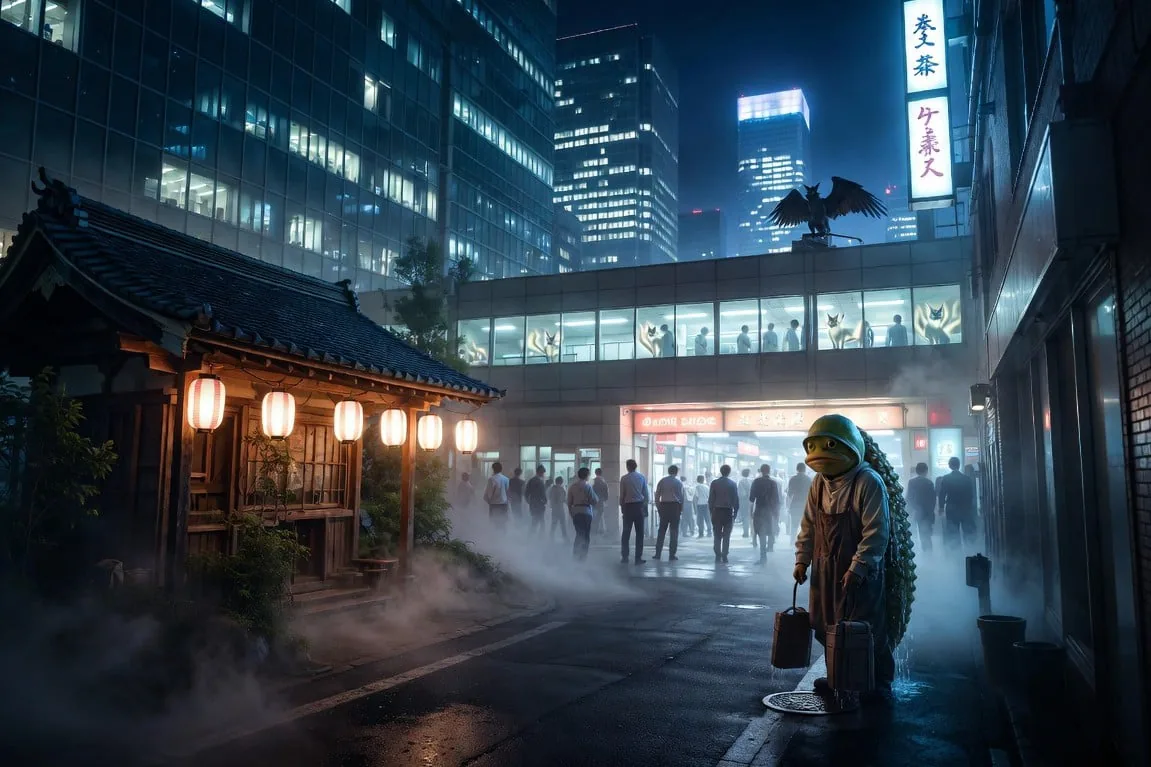
The Silent Watchers: A Guide to Yokai in Urban Japan
Most people believe yokai belong to deep forests and abandoned mountain shrines. But the truth is far stranger. In modern Tokyo, Osaka, and Yokohama, supernatural creatures have simply adapted. The Kappa, once a river dweller, now lurks near drainage tunnels and construction site ponds. The faceless Noppera-bō blends into crowds of salarymen. These yokai never left—they changed their camouflage. Ancient myths tell us that supernatural creatures are born from human emotion, and cities produce fear, loneliness, and wonder in abundance. The silent watchers are always present, hiding in plain sight between neon signs and vending machines.
What do these urban yokai want? Unlike their rural ancestors, city-dwelling Japanese demons and spirits feed on different energies. The Azuki-arai, once heard washing beans by rivers, now haunts automated laundromats. Fox spirits have been spotted near 24-hour convenience stores, testing the honesty of night shift workers. Folklore tales from the Edo period describe yokai as mirrors of social anxiety. Today, that mirror reflects train delays, overwork, and digital isolation. Ancient myths never die—they simply find new hosts and new shadows to inhabit. The silent watchers are still watching, waiting for you to notice them.
To recognize urban yokai, you must change how you see. The slippery floor that nearly breaks your neck? That might be a playful Kappa. The face in the window reflection that disappears when you turn your head? A classic supernatural creature known as the Kage-onna (Shadow Woman). Samurai legends often warned that yokai appear when you are distracted by technology or greed. Shinto gods taught that awareness is the first shield against mischief. If you walk through Shibuya crossing with your eyes open, you might spot the telltale signs: wet footprints without a source, shadows moving against the wind, or a sudden cold draft in a sealed room.
Among the most common urban yokai today are the Furutsubaki-no-rei (old camellia tree spirits) trapped in city parks, and the Ittan-momen (rolling cotton roll) now tangled in elevator shafts. Japanese demons like the Otoroshi, who once guarded mountain passes, now stand silently in apartment hallways. Dragons and fox spirits behave differently in cities—they become territorial and nervous. Folklore tales collected in the 2020s describe supernatural creatures using smartphones to lure the curious into abandoned buildings. Ancient myths warned that yokai mimic technology. That unknown caller with static on the line? You should think twice before answering.
How can you protect yourself from urban yokai without becoming paranoid? The old methods still work. Shinto gods taught that salt, iron, and loud sounds disrupt supernatural creatures. Carrying a small bell or wearing red cloth (a traditional ward against Japanese demons) helps. Fox spirits dislike dog fur, while most yokai cannot cross lines of purified ash. Samurai legends recorded that brave warriors would announce themselves before entering dark rooms, because supernatural creatures respect courage. Ancestral myths also suggest keeping one small offering—a rice ball or coin—by your doorway. Yokai who receive a gift are bound by ancient myths to leave in peace.
Ultimately, the silent watchers are not enemies. They are neighbors. Folklore tales from every prefecture agree that yokai test human character, not destroy it. If you show respect, fox spirits may guide you to lost items. Japanese demons may reveal hidden dangers. Dragons sleeping under subway tunnels maintain the earth's balance. Shinto gods never exiled these supernatural creatures—they integrated them. So walk gently through your city. Bow to old trees and murky waters. The ancient myths are alive, and the silent watchers are waiting for you to remember their names.