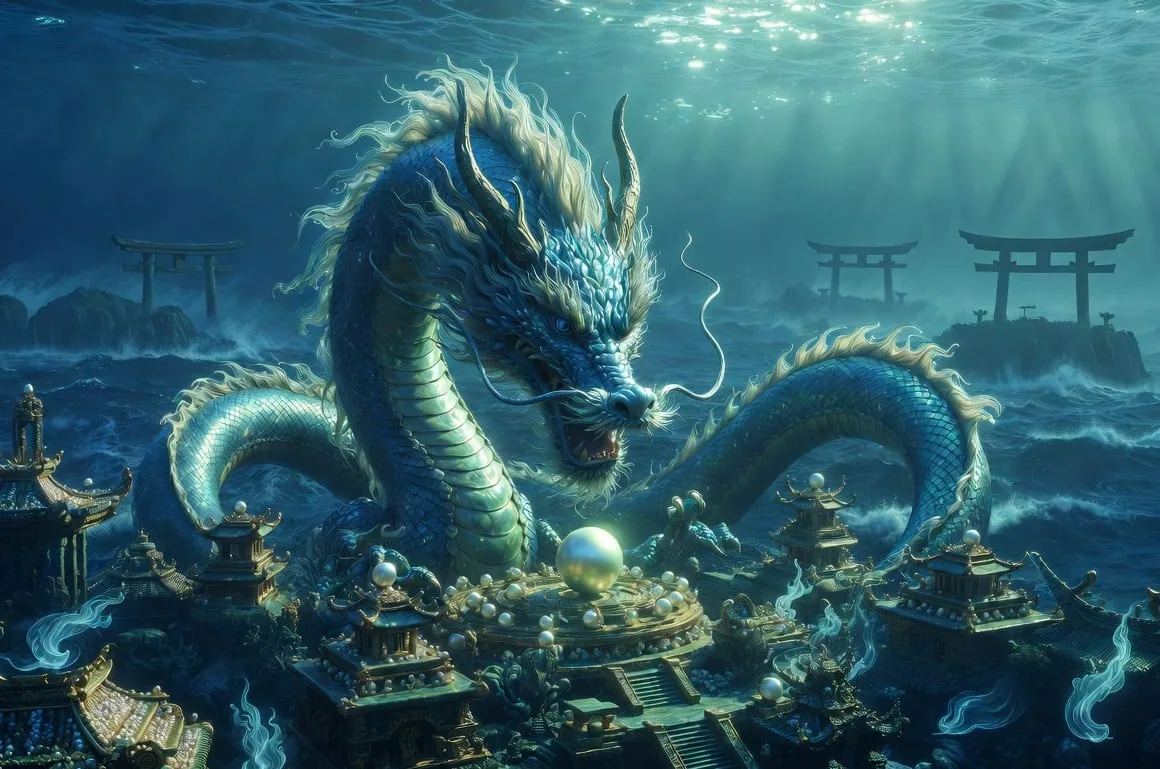
Ryujin’s Kingdom: Dragons, Tides, and the Emperor’s Bloodline
Among all supernatural creatures in Japanese mythology, dragons hold the highest rank after Shinto gods themselves. Unlike Western dragons who hoard gold and breathe fire, Japanese dragons rule water, weather, and time. The greatest of them is Ryujin, the Dragon King of the Sea, who lives in a coral palace beneath the waves. Ancient myths describe Ryujin as a supernatural creature controlling all tides, storms, and earthquakes. Samurai legends claim that entire fleets were saved or sunk by dragons who judged the hearts of warriors. Folklore tales connect dragons directly to the Imperial family, making them political symbols as well as spiritual forces. Without dragons, Japan would simply sink into the ocean.
The connection between dragons and the Emperor’s bloodline begins with a folklore tale about a princess and a hunter. Ancient myths record that a man named Hoori lost his brother’s fishing hook and went searching for it in Ryujin’s palace. There, he married the Dragon King’s daughter, Otohime. After three years under the sea (which felt like a moment), he returned to land with two gifts: the lost hook and the power to control tides. Samurai legends say that his grandson became the first Emperor of Japan. This means the Imperial family carries divine blood from dragons. Shinto gods blessed this union, and fox spirits witnessed the wedding. Japanese demons dared not interfere. Yokai of all kinds bowed to the dragon princess.
Dragons in Japanese mythology have physical traits that distinguish them from other supernatural creatures. They have three claws (not four or five), a serpentine body, a camel’s head, a deer’s horns, and scales of a carp. Ancient myths describe dragons as capable of shrinking to the size of a mouse or expanding to cover the sky. Folklore tales warn that dragons are patient but not forgiving. Samurai legends tell of warriors who poisoned dragon pools and died of mysterious floods years later. Shinto gods appointed dragons as guardians of sacred springs and waterfalls. Unlike fox spirits who play tricks or Japanese demons who rampage, dragons act only when balance is threatened. They are the silent kings of supernatural creatures.
Ryujin’s palace, known as Ryugu-jo, is described in ancient myths as made of red and white coral, with fish scales for roof tiles and dragon pearls that control the weather. Samurai legends claim that heroes who visited the palace returned with magical knowledge. Folklore tales mention that time moves differently inside—three days feel like thirty years. Supernatural creatures like yokai and fox spirits serve as Ryujin’s messengers. Japanese demons are banned from entering. Shinto gods sometimes visit for underwater council. The tide jewels (kanju and manju) kept in the palace allow dragons to raise or lower the sea. Ancient myths say that if Ryujin ever gets angry enough to drop both jewels, all coastal cities will vanish.
The relationship between dragons and Shinto gods is one of mutual respect rather than worship. Amaterasu, the sun goddess, treats dragons as allies. Susanoo, the storm god, once killed a dragon to retrieve a sword. That sword became one of the Three Sacred Treasures of Japan. Samurai legends consider this dragon blade the ultimate symbol of authority. Folklore tales from Okinawa describe dragons as ancestors of royal families. Fox spirits try to avoid dragons because supernatural creatures of the sky cannot trick those of the sea. Yokai whisper that dragons see the future through ripples in water. Ancient myths record that Japanese demons once challenged a dragon to a battle—and were turned into stone crabs on the ocean floor.
Today, dragons are everywhere in Japan. Shrines dedicated to dragon gods receive prayers for rain and safe childbirth. Samurai legends of dragons appear in kabuki theater and tattoo art. Folklore tales about dragons are taught in elementary schools. Ancient myths of Ryujin inspire ocean conservation efforts. Shinto gods still communicate through dragon priests at certain temples. Fox spirits and yokai are celebrated in festivals, but dragons are revered. Japanese demons are feared, but dragons are respected. Supernatural creatures come and go, but dragons remain eternal. The Emperor’s bloodline still honors the ancient pact: respect the sea, and the dragons will protect the land. Break that promise, and Ryujin’s kingdom will remind you why ancient myths call the ocean the most powerful supernatural creature of all.